
Appendices
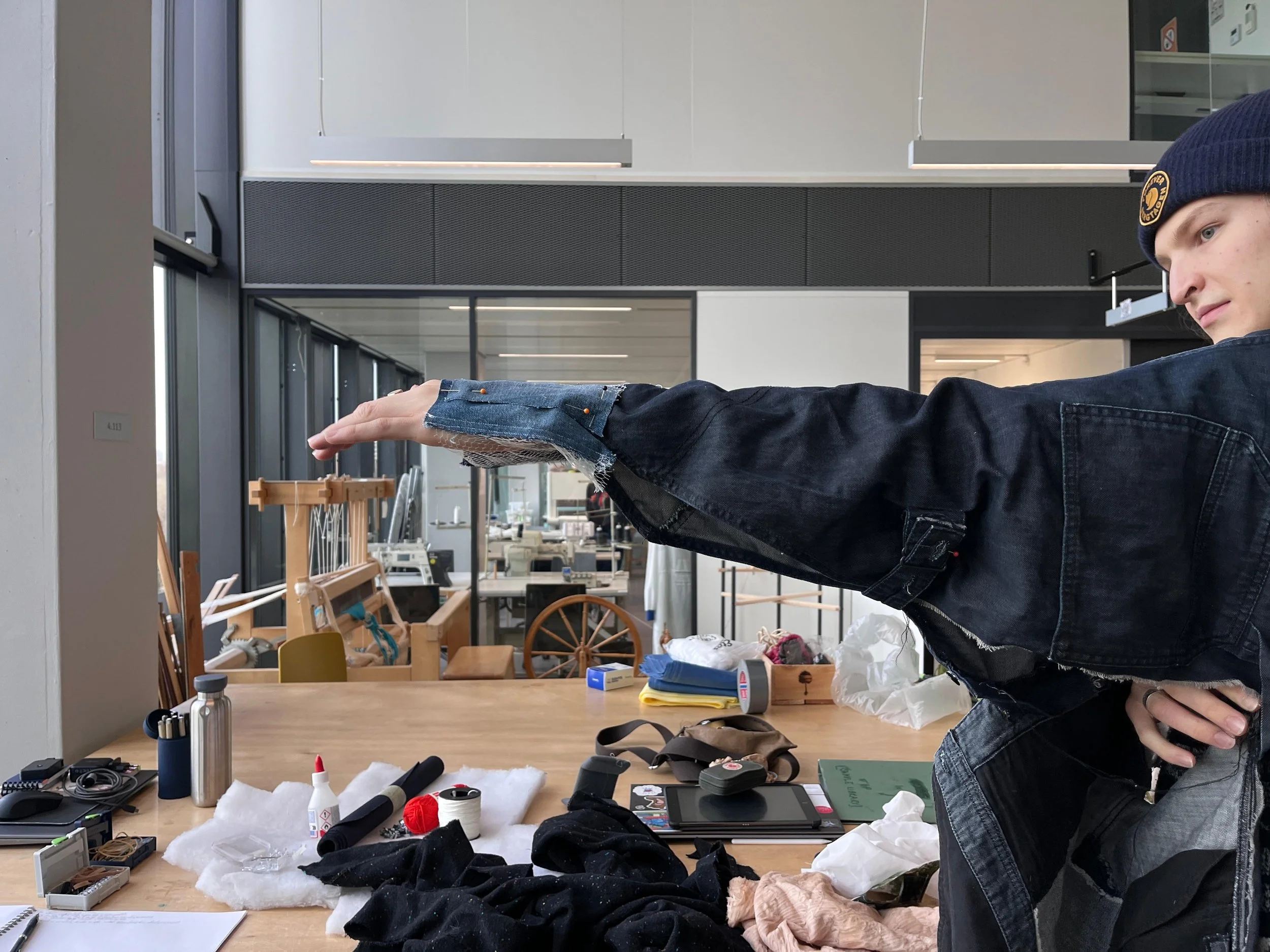
Positionality
I am a student at the Eindhoven University of Technology in the Netherlands. I would like to acknowledge my access to education at European Union standards, which allows me to afford time and resources to consider speculative concepts such as post- growth.
In the world, where core well-being values such as safety and health are not commonly provided, I find the ability to design for a goal of improving well being within planetary boundaries to be my privilege.
My positionality as a European design student with access to university-grade fabrication equipment and institutional support shapes my perspective and defines what I can and cannot initially see.
I am surrounded by resourced academic settings, and often address an audience of designers and researchers in comparable contexts.
In my future projects, I want to expand my context through involving perspectives from garment-producing countries, from textile recycling workers, and from communities directly affected by textile waste.
Expertise Areas
Throughout this document, inspired by my designer practice of system thinking, I have described Expertise Areas I have developed throughout ID already in scenarios where they inform and complement each other. I would like to briefly reflect on each individually in this section.
Business and Entrepreneurship (BE)
Throughout more my two years of experience as a Textiles Sales Assistant at IKEA, informed by state of the art, academic research, I have learned, that unfortunately, Sustainability alone, which i highlight throughout my Personal Identity and Vision, is not the selling point.
In my designer practice, I want to use existing research on circular economy to creatively craft value proposition that ‘sneak in’ sustainability as an additional factor shaping a good business model, that I can present to stakeholders.
Creativity and Aesthetics (CA)
This has been the EA I was fascinated by already from the first project ever introduced. I have learned that aesthetics and creatively presenting or pitching your concept could be what makes you stand out from other working prototypes.
I hardly ever have a project, where my creativity isn’t sparked, or that a good aesthetic is not appreciated.
Considering complex systems, designers with Creativity & Aesthetics are needed to navigate them, while carefully adjusting the ‘zooming in’' and ‘out’' of the scope of the project.
User and Society (US)
We live in a society of users, where every purchase, design decision or action can have impact on environment in one way or another.
Considering this impact, it’s easy to fall into a trap of individual responsibility, which distracts us, being overly worried about our individual impact, while large corporations, emitting more in months, that we could do in a single lifetime, continue to process and pollute the nature.
I aim to foster adaptation to circular practices that isn’t grounded in the ‘scaring’ of the users with consequences, but rather making it convenient for users to choose.
Technology and Realization (TR)
Each idea created on paper, will likely need to eventually evolve into a tangible prototype. Technology and Realizaton EA for me is the process of getting an idea out of that 2D plane and giving it life in the 3D world.
Additionally, what I also believe is a huge part of this EA is reimagining existing infrastructure to fit modern solutions. I have partly discussed that in my FBP, but for example, wool could serve as a pathway to regenerative fashion, until other biomaterials develop a tools needed for scaling
Math, Data and Computing (MDC)
Finally, the are that before Year 3 I was worried I haven’t developed enough in. Luckily, throughout the Exchange, I have learned how to analyze current trends and use this data in my creative process. The process of creating zero-waste patterns also required a lot of different layouts to be calculated and tested before finally cut.
More recently, I have also been working closely with data carriers, such as the QR code implementation in my FBP.
Sustainability, despite not officially defined as a separate Expertise Area (yet), has become a standard and tool for filtering my design decision, while Design Research has become a methodology I learn to use to develop EAs through my projects.
Organization, Collaboration and Documentation
There are limits to what an individual student can achieve in the scope of 6 months. The Final Bachelor Project has been one of the first serious projects that I have developed on my own.
Despite being individually responsible by my deliverables, developing a project within the Crafting Wearable Senses Squad, still made it feel like I was a part of community. I participated in many feedback sessions, reading groups, or simply motivating each other to study in the squad space.
Similar, for the Wearable Senses LAB, where no matter which machine I wanted to use, there was always someone to explain how it work, or to simply have a vivid conversation sparked with our latest samples.
I really enjoyed this process, as being in CWS Squad community, made it less scary to develop everything by myself.
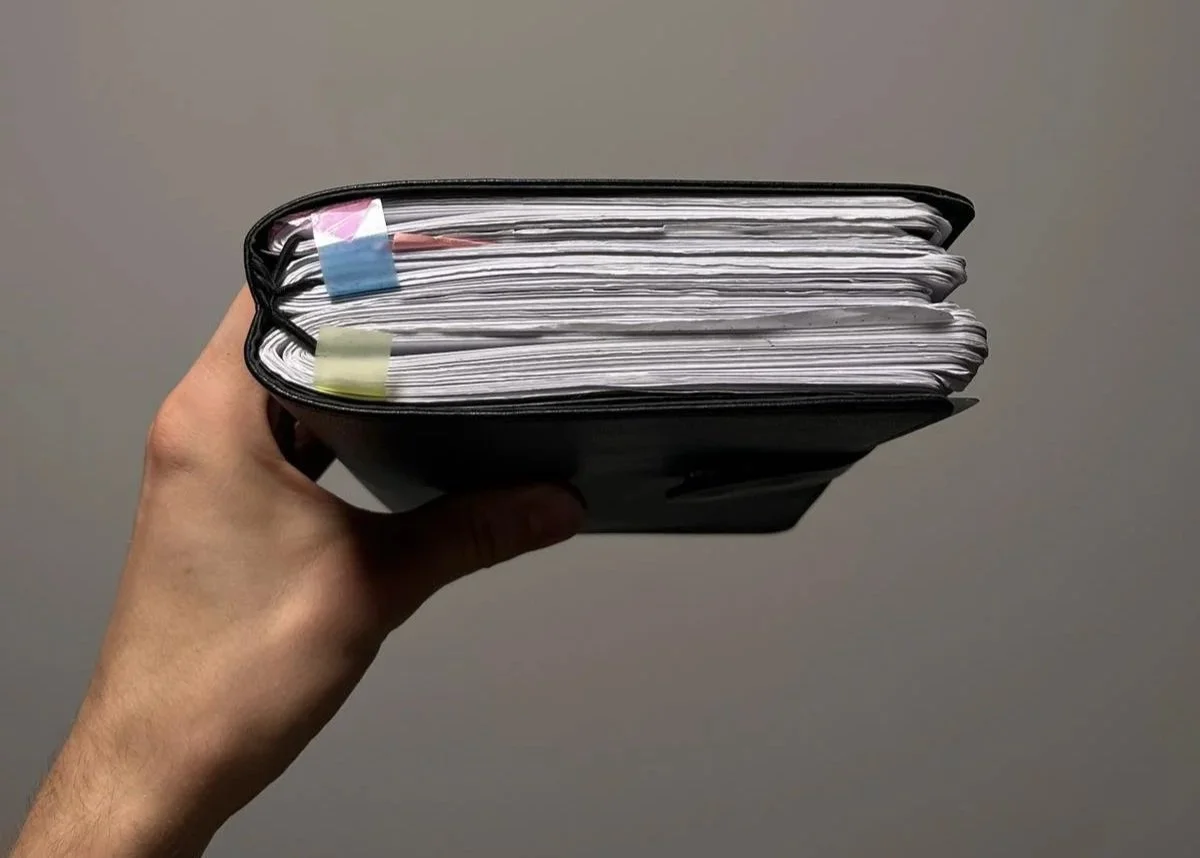
Additionally, the research through design methodology, applied throughout my FBP, led to emergent knowledge, which I made sure to document in my portable and physical dummy.
Physical note taking has worked for me as a documentation and ideation method so far throughout Industrial Design. However, I have identified one weakness of this method, which is sharing my insights.
As I move forward, I might need to develop a system that balances the freedom of a pen and paper, along with an automatic, accessible digital backup of my physical? notes.
Future
I believe that completing the Bachelor's curriculum of Industrial Design at TU/e complemented by extracurricular activities (described in Projects) curated by me, have equipped me with knowledge, experience and tools necessary to continue my education and development through applying to Industrial Design Master's program.
I see value in redefining the measures of success, such as transitioning from targeting the increase of Gross Domestic Product (GDP) to focusing on increasing well-being, while staying within planetary boundaries. This challenge is described by the economic philosophy, as well as a design movement of post-growth [1,2].
To build onto this theory, I have decided to specialize in two expertise areas throughout my master's degree: User & Society and Business & Entrepreneurship. The connection between the two, creating a foundation for my master's can be already seen in my FBP, as I tried to bridge the gap between legislative action and stakeholder adaptation through design intervention.
The goal for my Master's is to use circular economy principles to inform my design decisions with a mission of fostering conscious customer behavior, or even making it more extreme, to design a way out of the current system powered by overconsumption, towards transitioning to one where progress can be measured in terms of well-being, instead of GDP, and where the nature is regenerated, instead of being polluted.
References
[1] Jackson, T. 2021. POST GROWTH : life after capitalism. Polity Press.
[2] Post Growth Institute: 2018. https://postgrowth.org/.